A job search that fits the career you've built.
Built out of a real search, not a product roadmap. It is free, and nothing you type into it ever leaves your device.
Run The Mission is Bradley's podcast from Wendling Nonprofit Consulting: nonprofit operations, with a job search series beside these notes. Every episode
Six weeks ago I sat down on a Tuesday morning with fourteen tabs open and a spreadsheet I had already stopped trusting. By noon I had applied to four roles. Two were reposts of listings I had applied to in June. One had no salary band and a requisition date from March. I did not learn any of that until after I had rewritten a resume for it.
That was the morning I stopped treating the search like a task list and started treating it like an operation with a broken intake process.
I read operational systems for a living. I have sat on the hiring side of this market for 25 years and I have spent this year watching the other side of it up close. When intake is broken, you do not work harder downstream. You put a gate at the front.
What I wrote in July, and what I did about it
In July I published a piece called Ghost Jobs: The Broken Signal. The short version: every serious study puts somewhere between one in five and one in three active listings in ghost territory, and the Bureau of Labor Statistics gap between openings and hires has sat near 30 percent since 2021 after a decade of tracking within 10.
The response to that article was not what I expected. Almost nobody argued the numbers. What came back, over and over, was a version of the same sentence: I do not need more listings, I need to know which ones deserve my hour.
I did not have a good answer. So I built one.
It is live at rolespect.com. It is free.
What it actually does
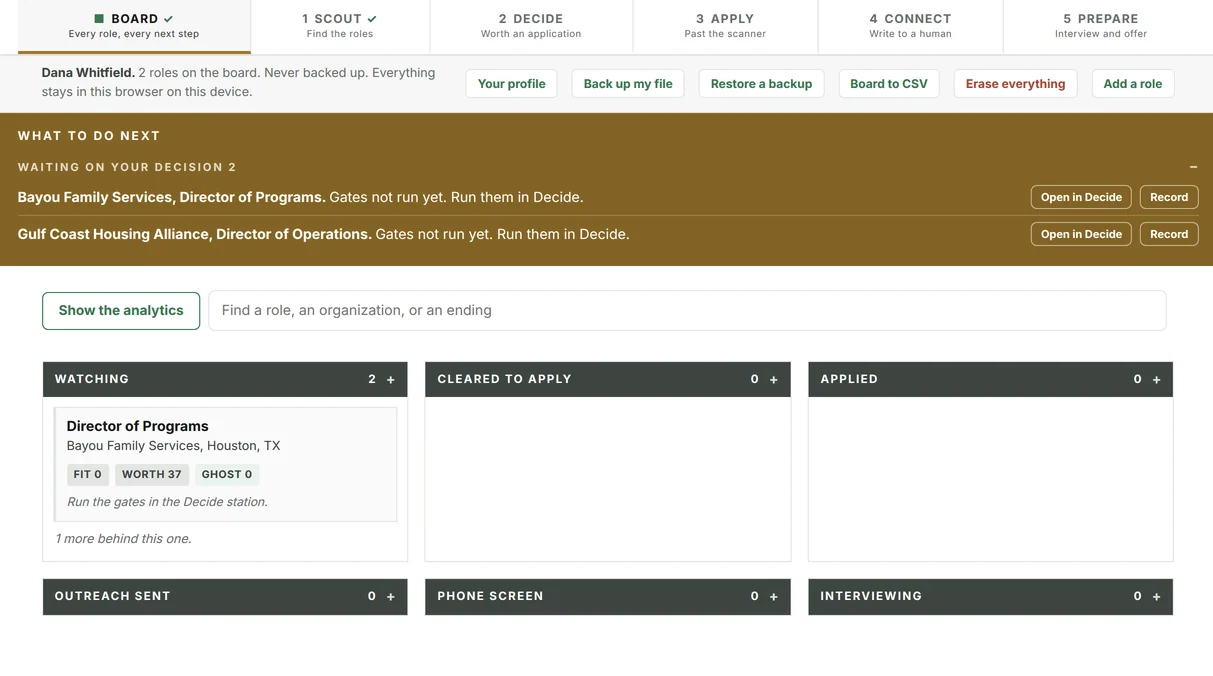
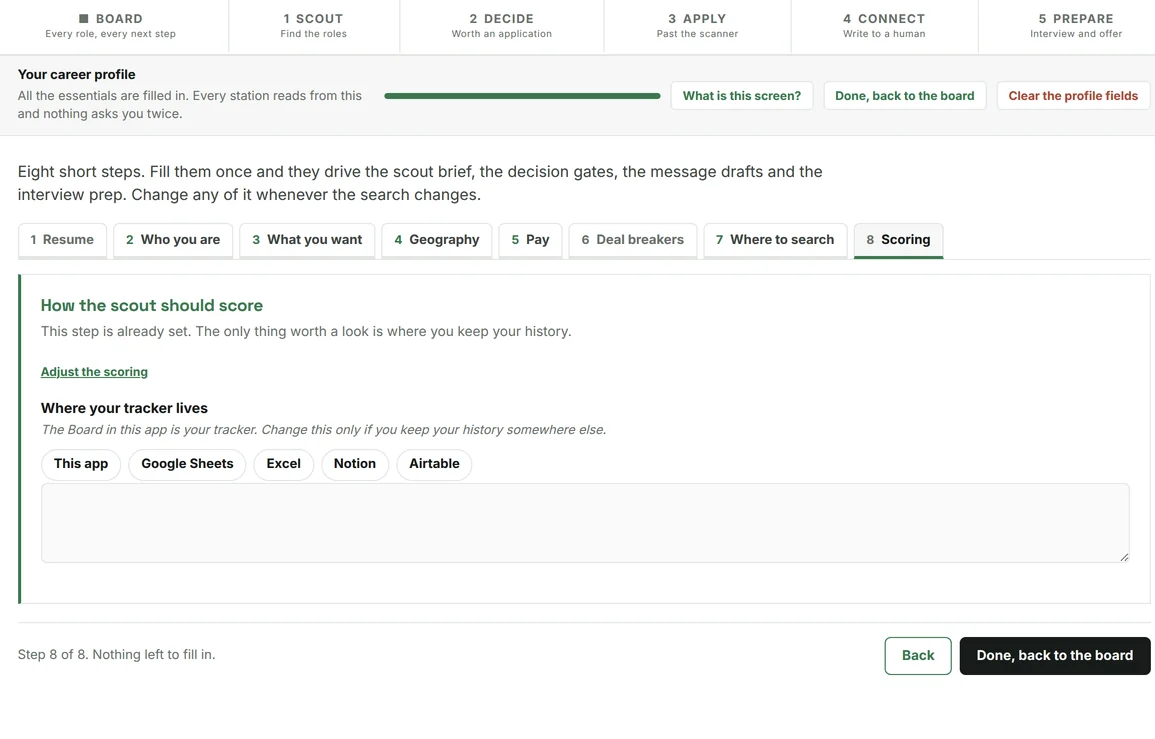
Rolespect is six stations and one Career File. You fill the Career File once with your titles, sectors, pay floor, and how far you will go. Every station reads from it, so you never type the same thing twice.
- Scout builds the daily search you run with an AI assistant. Ten hard gates and evidence rules, written into a prompt you paste into ChatGPT, Perplexity, Grok, or Claude. Free tiers work. Rolespect does not need an AI subscription and does not sell you one.
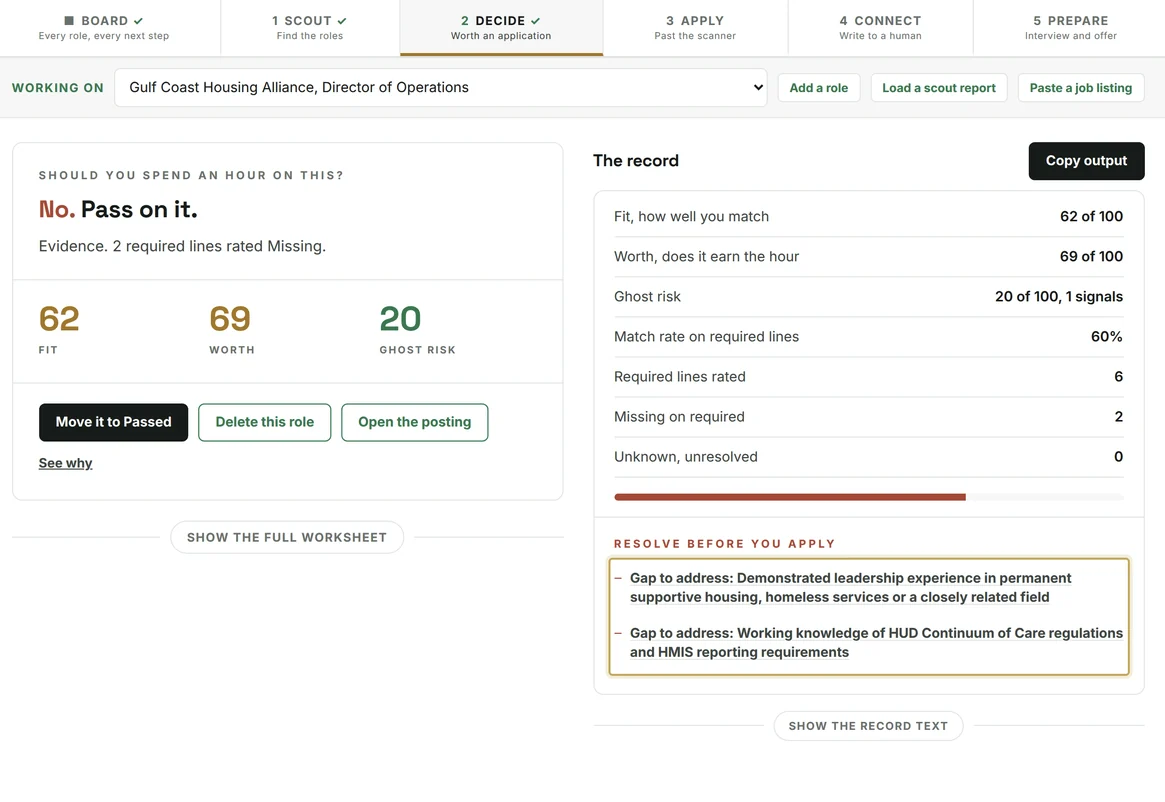
- Decide confirms the posting is real, then returns a verdict: Apply, Investigate First, or Pass. Six gates, eight weighted ghost job signals, and a careers page check. It prints the reasoning so you can disagree with it.
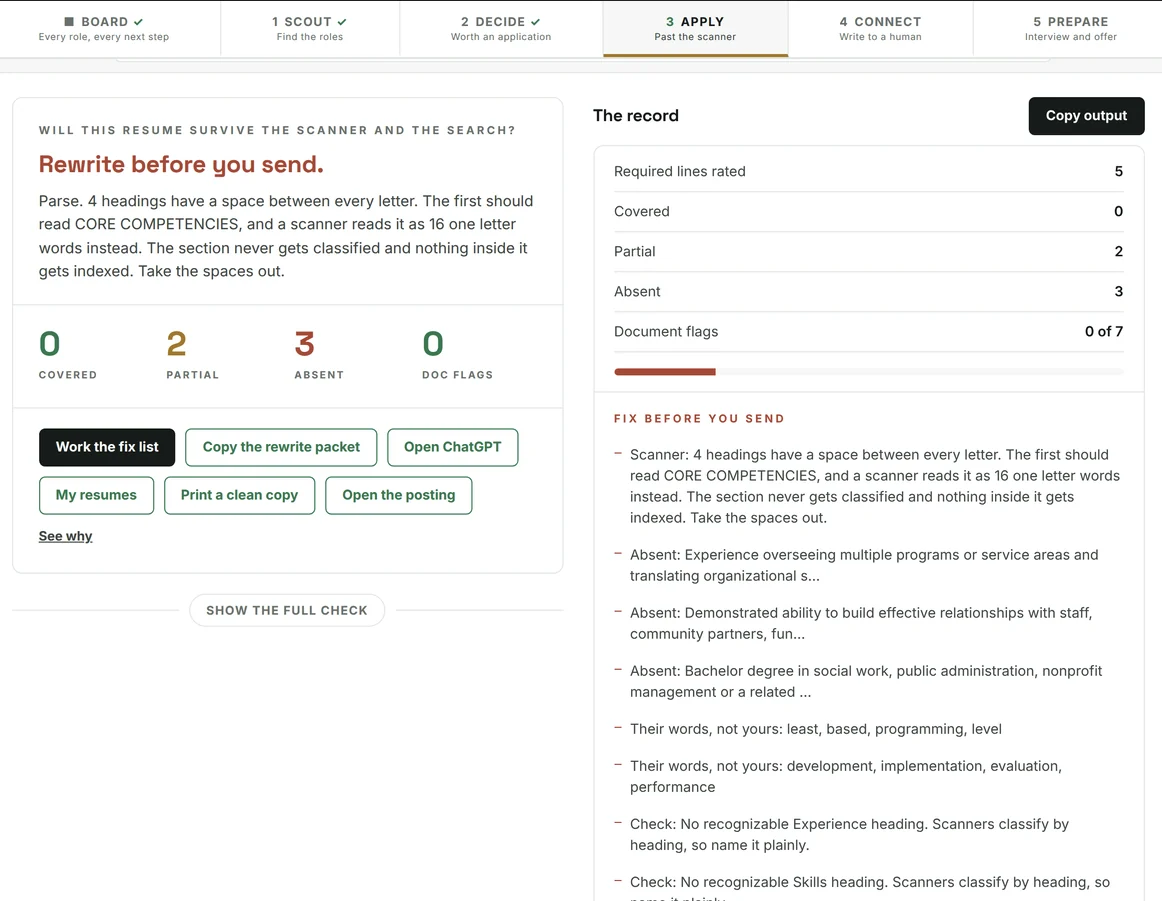
- Apply puts your resume against the posting line by line. Coverage gaps and scanner faults, before you send it instead of after.
- Connect gets you to a person instead of a portal. Thirteen templates and a follow up schedule that does the remembering for you.
- Prepare is eighteen evidence cards and an offer weighed nine ways, because salary is one dimension and the other eight are the ones people regret.
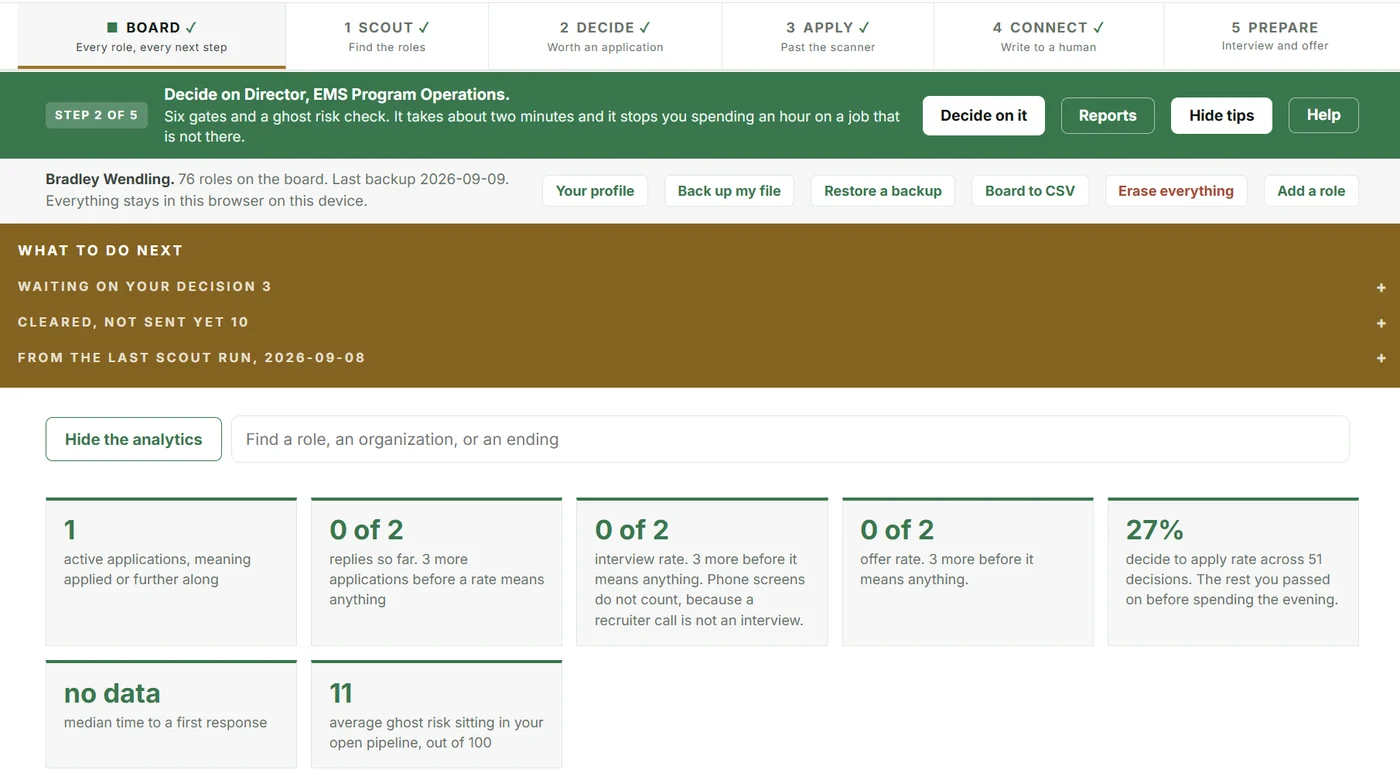
- The Board holds every role across nine active stages plus closed outcomes. After five applications it reports which sources actually produce interviews. After eight, which resume version does.
That last part is the one I care about most. Five months in, the search stopped being a feeling and started being data. You can see which board is wasting your time. That is not motivation. That is a signal.
The word every other tool refuses to say
Every job search product on the market is built to help you apply to more things, faster. Automatic resume rewriting. One click autofill. A match score that always finds something encouraging to say.
None of them will tell you not to apply.
Rolespect will. Hidden pay blocks the application outright. Eight ghost signals can close a role before you open a document. The verdict is scored against six published criteria, and Pass is a real outcome, not a soft warning.
I also declined automatic resume rewriting on purpose. If a machine wrote your resume, you cannot defend it in the room. I have read enough of those across a desk to know how fast it shows.
Yes, it is actually free
The two most common paid trackers run roughly $24 to $45 a month. Their free tiers cap you: one caps tracked roles in the low hundreds and lets you keep two resumes ever, the other caps you at ten roles and one resume. Interview prep sits behind the paid tier on both. Over a year of searching that is several hundred dollars, and neither one screens a posting for whether it is real. I keep a current row by row comparison at rolespect.com/compare rather than argue prices in a post.
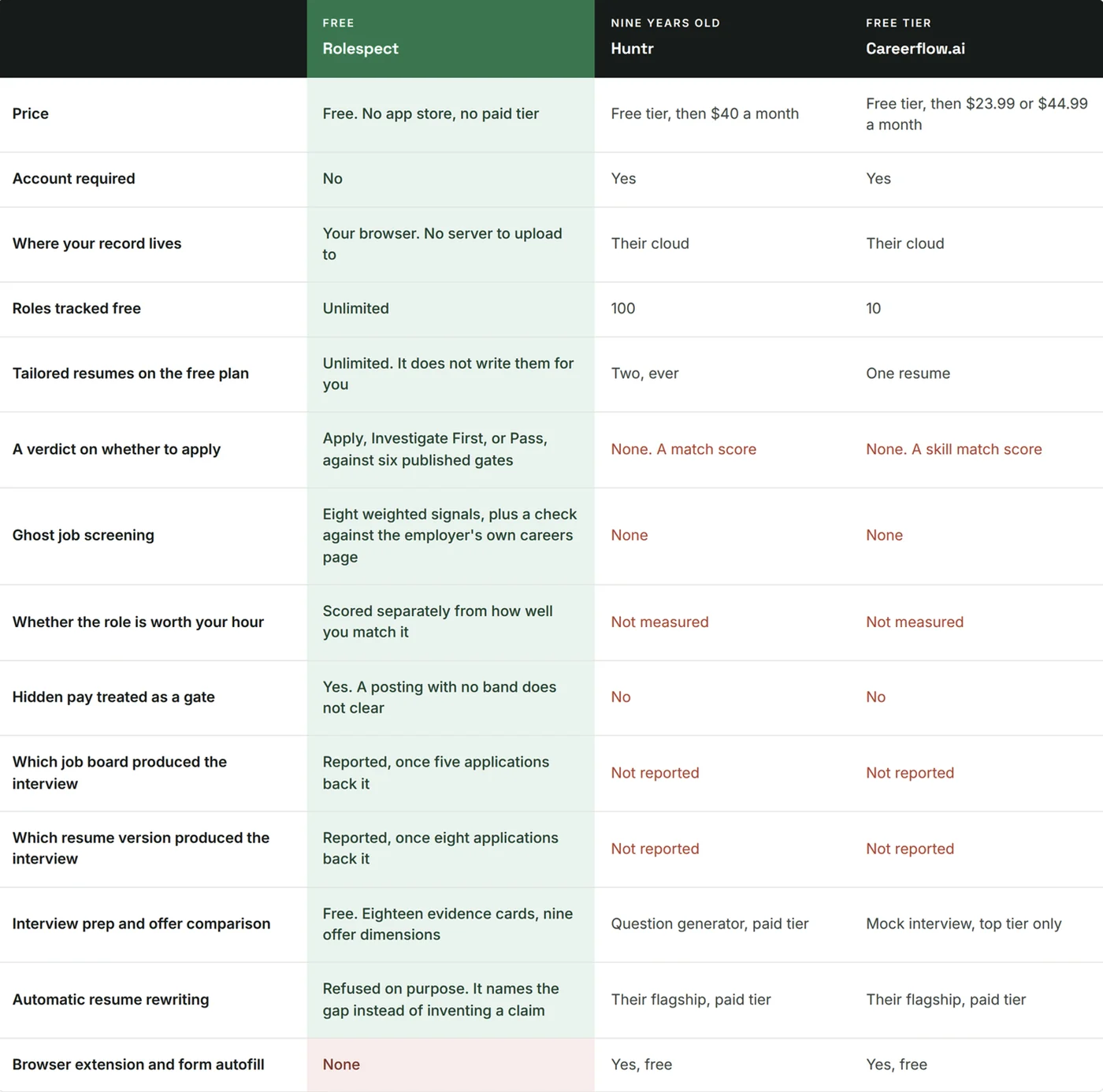
Rolespect is $0. Unlimited roles. Unlimited tailored resume versions. Interview prep included.
No account. No app store. No server. Your Career File lives in the browser on your device, and nothing is uploaded anywhere. Install it to your home screen and every station keeps running with no signal.
There is no paid tier. Not now, and not one waiting quietly to be built later.
I get asked why. Two reasons, and neither is charitable.
The first is that I built it for myself. I was going to use it whether anyone else did or not, and a paywall on my own tool would have been a strange thing to build.
The second is that the people who need this most are the people with the least room in the budget for it. Charging a monthly subscription for the software someone only needs because they lost their income is a business I am not interested in running.
I run a consulting practice. Nonprofits pay me to build operations infrastructure, and that is where my income comes from. Rolespect is not a funnel into it. The app does not ask for your email, because there is no account and nothing to send you.
What it does not do
I would rather you hear this from me than find it on day three.
There is no browser extension and no autofill. Nothing leaves your device, which also means nothing syncs between devices. You carry your Career File across with a file export, which is deliberate and still mildly annoying.
Desktop is the workbench. Phone is where you check in. Every session I have logged says the same thing, so I stopped fighting it and designed for both.
And it expects you to do the thinking. Rolespect is a gate and a scoreboard. It is not a machine that applies for you, and I am not going to build one.
Where it came from
Five months of watching this market from both sides built this. Every station exists because something broke in a real week: a role applied to twice, a posting that turned out to be a pipeline build, an interview walked into without the right three stories ready, a resume version nobody could prove was working.
I rebuilt it three times. It is on its third name. The current build has been field tested on and off a signal, on a phone in a parking lot and on a desktop at 6 a.m.
If you are searching right now, go use it. rolespect.com. Free, no account, nothing to install from a store.
And if it tells you to pass on something, that is not the tool failing. That is the tool doing the one thing nothing else on the market will do for you.
If you are hiring, I still want to hear what you are seeing on the ground. That is where the useful information has always been.
Bradley Wendling is a Houston based fractional COO for human services and food security nonprofits, and the creator of Rolespect. Wendling Nonprofit Consulting
A gate at the front of your search.
Rolespect confirms the posting is real, holds it against the gates you set once, and will tell you when to pass. Free, no account, and nothing you enter leaves the device.